
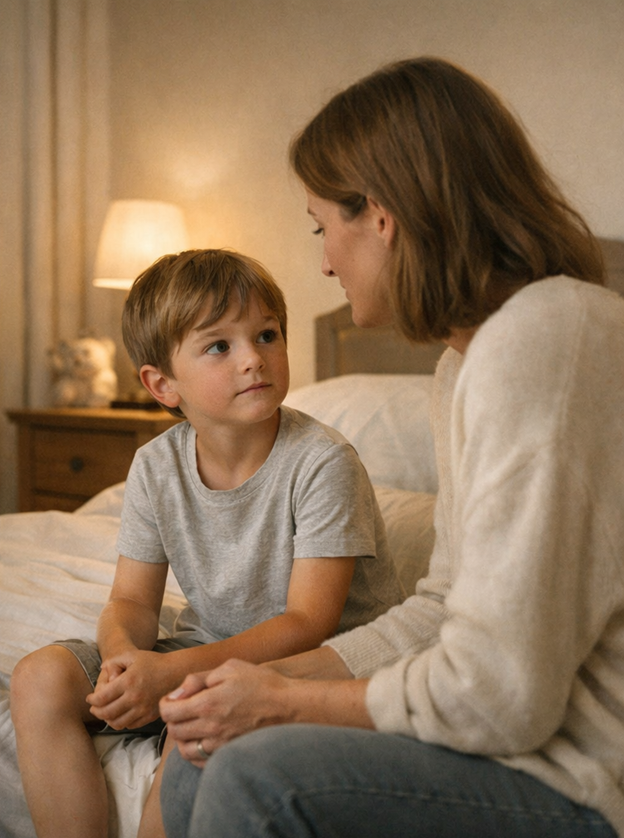

Introduction: Emotions Come Before Language
Long before children learn to speak, they feel.
They feel tension in their bodies.
They feel shifts in tone.
They feel distance, closeness, safety, and threat.
Emotions are not something children have — they are something children are
experiencing moment by moment. And yet, many parents arrive at emotional
moments feeling unsure, overwhelmed, or afraid of “making it worse.”
This article is not about controlling emotions.
It is about learning how to stay present with them.

The Developing Emotional Brain
Children’s emotional systems mature long before their cognitive control systems.
Neuroscience shows that the limbic system — the emotional center of the brain —
develops earlier than the prefrontal cortex, which is responsible for impulse control,
planning, and regulation.
In simple terms:
Children feel intensely before they can manage those feelings.
As Dr. Daniel Siegel explains:
“Children are not giving adults a hard time; they are having a hard time.”
This understanding shifts everything.
What looks like defiance may be distress.
What looks like drama may be dysregulation.
What looks like misbehavior may be a nervous system asking for help.
Why Emotional Reactions Feel So Big
Children experience emotions with their whole bodies.
A small disappointment can feel enormous because children lack:
- Perspective
- Emotional memory
- Regulation skills
Their nervous systems react quickly and fully. Tears, yelling, shutting down — these
are not choices. They are responses.
When adults respond with urgency, correction, or dismissal, the child’s system
escalates.
When adults respond with calm presence, the child’s system begins to settle.
Emotions as Messengers, Not Enemies
Every emotion carries information.
Anger may say: Something feels unfair.
Fear may say: I don’t feel safe yet.
Sadness may say: I’ve lost something important.
When we try to “get rid of” emotions, we lose access to their message.
Psychologist Carl Rogers wrote:
“When we listen with real understanding, we help people listen to themselves.”
Children are no different.
The Parent’s Inner Work
One of the most important — and difficult — aspects of supporting a child
emotionally is noticing our own reactions.
Many parents were raised to:
- Suppress emotions
- Move past discomfort quickly
- Value control over expression
When a child expresses big emotions, it can awaken unresolved feelings in the adult.
This is not a failure.
It is an invitation.
Before responding to a child, ask:
- What am I feeling right now?
- Am I reacting, or responding?
- Can I slow my body before addressing theirs?
Regulation is contagious.
Practical Tools for Daily Emotional Support
1. Name Without Judgment
Instead of fixing or questioning, reflect:
- “That was really frustrating.”
- “You look disappointed.”
- “Something didn’t go the way you hoped.”
Naming emotions helps integrate emotional and cognitive brain functions.
2. Stay Physically Available
Sometimes words are too much.
Sitting nearby, offering presence without pressure, communicates safety.
3. Avoid Emotional Time Limits
Phrases like “You’re okay” or “It’s not a big deal” rush the process.
Healing happens when emotions are allowed to complete their cycle.
4. Model Emotional Language
Children learn how to relate to emotions by watching adults:
- “I’m feeling overwhelmed, so I’m taking a breath.”
- “I was disappointed too, and it passed.”
Emotional Safety Builds Emotional Intelligence
Children who feel emotionally safe develop:
- Better self-awareness
- Stronger empathy
- Greater resilience
Emotional intelligence does not come from teaching children what to feel.
It comes from allowing them to feel — with support.
As attachment research consistently shows:
Connection precedes regulation.
Closing: The Long View
Understanding your child’s emotions is not about perfect responses.
It is about relationship over time.
There will be moments of uncertainty.
Moments of impatience.
Moments of repair.
And repair matters more than perfection.
When children feel emotionally held, they grow into adults who can hold themselves — and others — with compassion.