
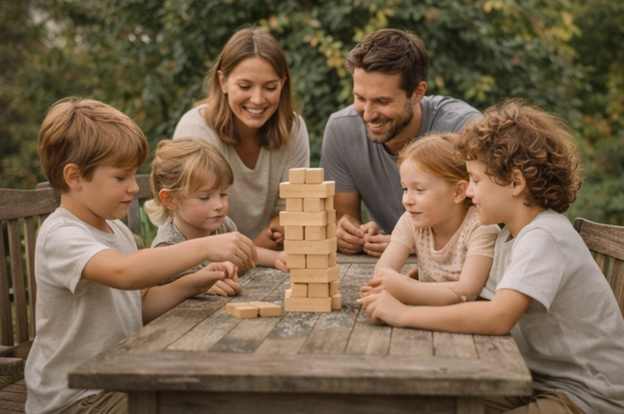

Introduction: Thinking Grows Through Experience
Children build their thinking through doing.
Cognitive development does not unfold in isolation. It grows inside movement, curiosity, relationship, and exploration. When children play, they engage their minds in a way that feels alive, embodied, and meaningful.
Play offers children the freedom to experiment, to test ideas, to change direction, and to make sense of the world at their own pace. Through play, thinking becomes flexible, creative, and integrated.
This article explores how play supports cognitive growth, why play-based learning feels so natural to children, and how everyday play experiences quietly build the foundations for thinking, problem-solving, and understanding.

Cognition as a Living Process
Cognition is more than acquiring information.
For children, thinking develops as a dynamic process that involves perception, movement, emotion, and relationship. When children engage with the world through play, their minds organize experience into patterns, concepts, and meaning.
Play allows children to:
- Explore cause and effect
- Practice memory and attention
- Experiment with ideas
- Develop flexibility in thinking
These skills grow organically when learning feels safe and engaging.
How Play Builds the Thinking Brain
Play engages multiple brain systems simultaneously.
When children play, they activate networks responsible for planning, sequencing, attention, and integration. These networks strengthen through repeated, joyful use.
Cognitive development through play includes:
- Noticing patterns
- Holding ideas in mind
- Adapting strategies
- Connecting past experiences to new situations
Each playful moment contributes to the architecture of thinking.
Executive Functions in Play
Executive functions support how children manage information and action.
Through play, children naturally practice:
- Planning (“What should I build first?”)
- Working memory (“Where did that piece go?”)
- Cognitive flexibility (“I’ll try a different idea.”)
- Self-monitoring (“That didn’t work — I’ll adjust.”)
These skills form the foundation for learning across all areas of life.
Play and Problem-Solving
Play invites experimentation.
When children encounter challenges during play, they engage in problem-solving without pressure. Towers fall. Rules shift. Stories change direction. Each challenge offers an opportunity to think creatively and persist.
Problem-solving in play builds confidence in thinking itself. Children learn that ideas can evolve and that mistakes are part of exploration.
Symbolic Thinking and Imagination
Symbolic play marks an important stage in cognitive growth.
When a child uses one object to represent another, abstract thinking begins to take shape. A block becomes a phone. A scarf becomes a river. These symbolic leaps strengthen the mind’s ability to hold and transform ideas.
Symbolic thinking supports:
- Language development
- Emotional processing
- Abstract reasoning
Imagination becomes a bridge between inner experience and outer understanding.
Language, Story, and Thought
Play often unfolds through story.
As children narrate their play, they practice organizing thoughts into sequences. They explore cause, consequence, and meaning. Language becomes a tool for thinking rather than a performance.
When adults join play gently — following rather than directing — children’s narratives often deepen. Vocabulary expands. Ideas connect.
The Role of Emotion in Thinking
Emotion and cognition develop together.
When children feel emotionally safe, their minds open. Curiosity thrives. Attention deepens. Play supports this emotional safety by offering autonomy and control.
Joyful engagement signals to the brain that exploration is welcome. This emotional foundation strengthens cognitive growth.
Types of Play That Support Cognitive Development
Construction Play
Building with blocks, magnetic tiles, or natural materials supports spatial reasoning, planning, and persistence.
Open-Ended Play
Materials without a fixed outcome invite creativity and flexible thinking. Children decide how objects are used and stories unfold.
Rule-Based Play
Games with simple rules introduce logic, strategy, and cooperation. Children practice anticipating outcomes and adjusting actions.
Imaginative Play
Pretend scenarios support abstract thinking, perspective-taking, and narrative structure.
The Adult’s Role in Play-Based Learning
Adults support cognitive development by protecting space for play.
This includes:
- Allowing time without interruption
- Offering open-ended materials
- Observing without correcting
- Joining play with curiosity rather than instruction
When adults trust the process of play, children trust their own thinking.
When Learning Feels Challenging
Some children approach learning cautiously.
Play offers a gentle entry point. Through play, learning becomes exploratory rather than evaluative. Children engage without fear of being measured.
Play-based learning builds internal motivation. Children learn because they are interested, not because they are required.
Everyday Invitations to Think Through Play
Cognitive growth happens in ordinary moments.
Simple invitations include:
- Asking open-ended questions
- Wondering together
- Allowing children to lead problem-solving
- Encouraging experimentation
These moments nurture thinking without pressure.
A Sara Soul Perspective
Play supports the whole child.
It integrates mind, body, and emotion into a cohesive experience of learning. When children play freely, thinking grows naturally and confidently.
Cognitive development flourishes in environments that value curiosity over performance.
Closing: Thinking That Feels Alive
Through play, children develop thinking that is flexible, creative, and resilient.
They learn how to explore ideas, adapt to challenges, and trust their own minds. These skills extend far beyond childhood, shaping how individuals learn, relate, and innovate throughout life.
Play lays the foundation for a lifetime of meaningful learning.